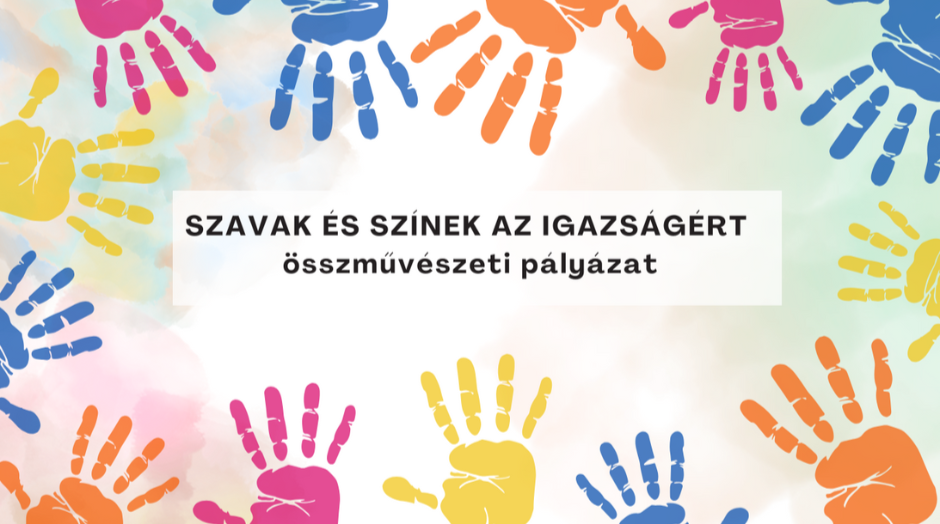
Words and Colors for Justice - Interdisciplinary Arts Competition
We have all experienced situations where a decision had to be made: do we speak up and stand up for ourselves, or do we simply endure what is happening? Sometimes this choice feels easy; at other times it is accompanied by fear, uncertainty, or discomfort. These are exactly the kinds of situations addressed by the Words and Colors for Justice interdisciplinary arts competition, which offers students in grades 5-12 the opportunity to creatively express what it means today to stand up for themselves and for others.
A total of more than 61 entries were submitted across the competition’s three creative categories. In the Create with Colors and Shapes category, students could apply with drawings, paintings, photographs, graphics - in short, any kind of visual art. The Power of Words category welcomed short stories, essays, fairy tales, and poems. The third category, Thoughts in Motion, provided space for applicants who wished to explore this serious and thought-provoking topic through dance, music, or even a short film, presented in a video of up to three minutes. The best works will compete for valuable prizes, and several of the submitted creations will also be showcased in Budapest, where all applicants will be warmly welcomed.
Why is the theme of this competition so important? The campaign focuses on self-advocacy, managing school conflicts, and standing up for others. The call for submissions raises several questions that frequently arise in everyday life:
- How can young people stand up for themselves and for others in school or community situations?
- What does “saying no” mean as a strategy of self-advocacy?
- What tools help young people protect themselves and support their peers?
These are not theoretical questions. Students encounter them day after day: when they are teased, left out, when someone mocks a classmate, or when they have to decide whether to voice their opinion in a disagreement. According to E-tanoda’s call, the focus is specifically on self-advocacy, the prevention of school bullying, and standing up for others - precisely those situations that are very much part of young people’s lives.
Many people think that standing up for something is always loud, sudden, and about demonstrating strength. In reality, it most often begins with small gestures—setting boundaries by expressing what is acceptable and what is not, or saying no, which is not impolite but rather a way of protecting one’s own mental well-being. Every small step carries great significance. This is why the competition offers an excellent opportunity for students to strengthen what they are already doing well and to show, through their own eyes, what justice, standing up, courage, and the power of community look like to them.
You are a hero in your own story!
This does not mean that everyone has to save the world. Heroism often means paying a little more attention to ourselves and to one another. It means not staying silent when someone is being hurt. It means daring to say no—or asking for help when needed. Often it comes down to a small decision: standing up for something that matters, protecting yourself or someone else, being honest even when it would be easier to stay in the background.
Heroism is also listening to someone who is in a difficult situation. Being mindful of how you speak to others. Saying no to something that would harm you. And saying yes to an opportunity that helps you grow closer to who you truly are.
In your own story, the rules are not written by others. You are the one who decides how you want to be present in the world, how you respond in challenging situations, and how you stand up for someone else—or for yourself. And perhaps now is the moment to show all of this in colors, in words, or in movement. Because your voice, your story, and your courage matter too.
This project is implemented with the support of the European Union’s “Citizens, Equality, Rights and Values” (CERV) programme. The support of the European Commission does not imply approval of the content of the activities carried out within the framework of the project, which reflects solely the views of the implementers, and the Commission cannot be held responsible for any use that may be made of the information contained therein.
