
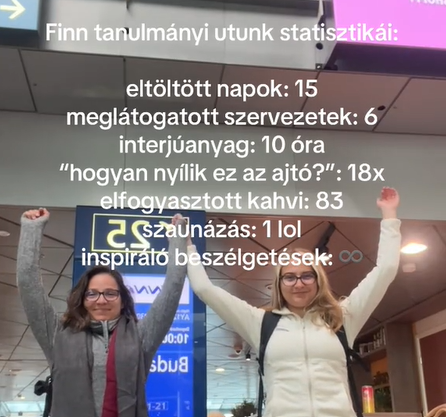
Finnish experiences at a Hungarian conference – what did we bring home that is worth passing on?
On August 28, the “Play, Learn, Opportunity” conference organized by E-tanoda was a special occasion: two of our young participants took the stage not only as attendees but also as speakers to present what they had learned during their study trip to Finland.
The conference was held as part of an international cooperation project in which E-tanoda is developing a new educational game together with a Slovak partner company. The event focused on playful learning, showcasing different educational methods and approaches. Although our young participants did not specifically study gamification or game-based learning in Finland, they returned with something equally important: a new mindset.
“A genuine civic mindset”*

At the Finnish organizations, they saw that support is not about control but about partnership. A young person is not a task but a partner. Not someone to be “fixed,” but someone to be supported. Most of the good practices — relationship-based mentoring, involving young people in decision-making, and a stronger presence of empathy — could also work in Hungary, especially in learning support centers (tanodas). But not by simply “copying” them. These are not recipes, but rather guiding principles.
The clear message of the Finnish experience was that real change is not methodological, but cultural and mindset-based. This often requires rethinking leadership roles as well: shifting the focus from control to presence, and from supervision to trust.
“As a teacher or homeroom teacher, even jointly setting rules with students — a so-called ‘contract’ at the beginning of the school year.”*

At the conference, the young participants shared their experiences just two days after returning home — fresh, honest, and personal. They did not give a lecture, but started a conversation. They invited the audience to think together: what would you take home from this? What is one thing you would do differently starting tomorrow?
“Strengthening social connections” → mentoring each other across classes or even entire year groups*

Empathy in the online space, the conscious preparation of volunteers, and the question of how a community can become a truly supportive force were all discussed. The example of the “clubhouse” model was especially inspiring: it was not about creating a new institution, but about making space for connection — even if only one room or two hours a week are available.
Perhaps the most moving moment of the conference was when participants began to plan for themselves: what would be your “first small step”? A different kind of question to a mentee. A quieter kind of presence. A shared decision. An online message that is not about administration, but about care.
"They focus on strengths, not weaknesses”*
“Supporting each other’s growth”*

It became clear to everyone that the essence of the Finnish experience lies in a culture of mindful presence and genuine attention. These ways of thinking can also be learned and applied at home.
At E-tanoda, this is where we are starting now: we are consciously integrating empathy into our online work, adopting new models in organizational practice, and relearning what it means not to lead from above, but to accompany and support.
“Using online communication. Instead of simply saying ‘I’m listening,’ expressing the concrete physical situation: ‘I’m sitting here, I’ve put everything else aside, so I can focus only on you.’”*

Because good practices cannot be copied word for word. But the courage and attentiveness to work with humanity, whatever we are doing — are learnable.
*Participants’ ideas and comments — what stood out to them.
This project is implemented with the support of the European Union’s “Citizens, Equality, Rights and Values” (CERV) programme. The support of the European Commission does not imply approval of the content of the activities carried out within the framework of the project, which reflects solely the views of the implementers, and the Commission cannot be held responsible for any use that may be made of the information contained therein.
